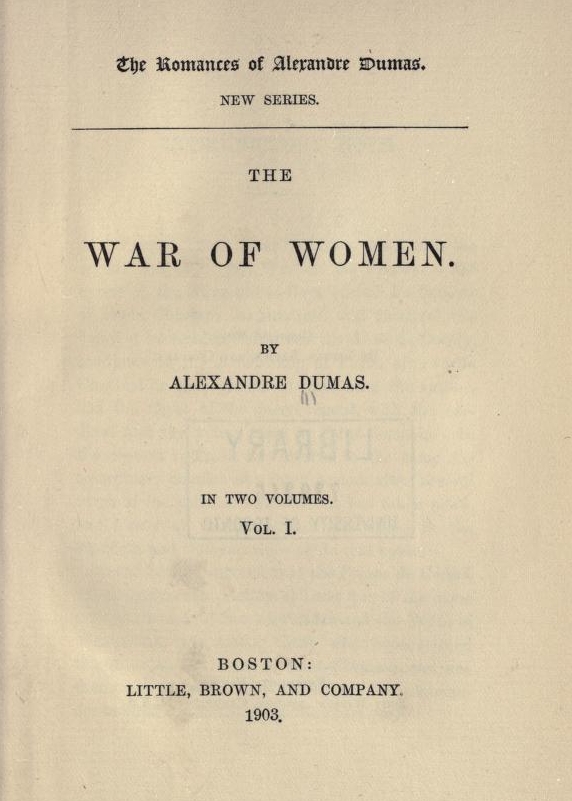
THE
WAR OF WOMEN.
BY
ALEXANDRE DUMAS.
IN TWO VOLUMES.
VOL. I.
BOSTON:
LITTLE, BROWN, AND COMPANY.
1903.
INTRODUCTORY NOTE.
In "Twenty Years After" Dumas dealt with the earlier stages of theWar of the Fronde,—the arrest of the three counsellors of theParliament of Paris, Charton, Blancmesnil, and Broussel, the "day ofbarricades," of which the Abbé de Gondy, coadjutor to the Archbishopof Paris, afterwards Cardinal de Retz, claims to have been the author,and the flight of the queen regent, with the cardinal and the youngking, to Saint-Germain. In the present volumes he reverts to the sameextraordinary conflict at a later period, after several turns of thepolitical kaleidoscope had taken place, and nearly all the prominentpersonages in the kingdom had changed sides again and again.
It will be remembered that the Prince de Condé, whose memorable victoryat Lens was of the same year as the day of the barricades and the Peaceof Westphalia, was among those who accompanied the queen and cardinalto Saint-Germain, and was then, and for some time thereafter, thecommander-in-chief of the troops of the court party.
But when he had had the honor of escorting the court back to Paris intriumph, he amused himself by making sport of it. "Considering that hewas not rewarded in proportion to his glory and his services," saysVoltaire, "he was the first to ridicule Mazarin, to defy the queen, andinsult the government he despised....
"No crime against the State could be imputed to Condé; neverthelesshe was arrested at the Louvre, he and his brother Conti, and hisbrother-in-law Longueville, without ceremony, and simply becauseMazarin feared them. The proceeding was, in truth, contrary to alllaws, but laws were disregarded by all parties.
"The cardinal, to make himself master of the princes, resorted to apiece of knavery, which was called shrewd politics. The Frondeurs wereaccused of having made an attempt upon the Prince de Condé's life;Mazarin led him to believe that it was proposed to arrest one of theconspirators, and that it was advisable for his Highness, in orderto deceive the Frondeurs, to sign the order for the gendarmes of theguard to be in readiness at the Louvre. Thus the great Condé himselfsigned the order for his own detention. There could be no better proofthat politics often consists in lying, and that political clevernessconsists in unearthing the liar.
"We read in the 'Life of the Duchesse de Longueville,' that the queenmother withdrew to her little oratory while the princes were beingsecured, that she bade the king, then eleven years of age, to fall uponhis knees, and that they prayed earnestly together for the success ofthe undertaking....
"A striking proof of the manner in which events deceive men as to theirresults is afforded by the fact that the imprisonment of the threeprinces, which seemed likely to calm the factions, actually excitedthem to fever heat. The mother of the Prince de Condé, although exiled,remained in Paris, despite the court, and presented petition afterpetition to the Parliament. His wife, after passing through innumerabledangers, took refuge in the city of Bordeaux; with the assistance ofthe Ducs de La Rochefoucauld and Bouillon, she incited a revolt in thatcity, and enlisted the aid of Spain."...